
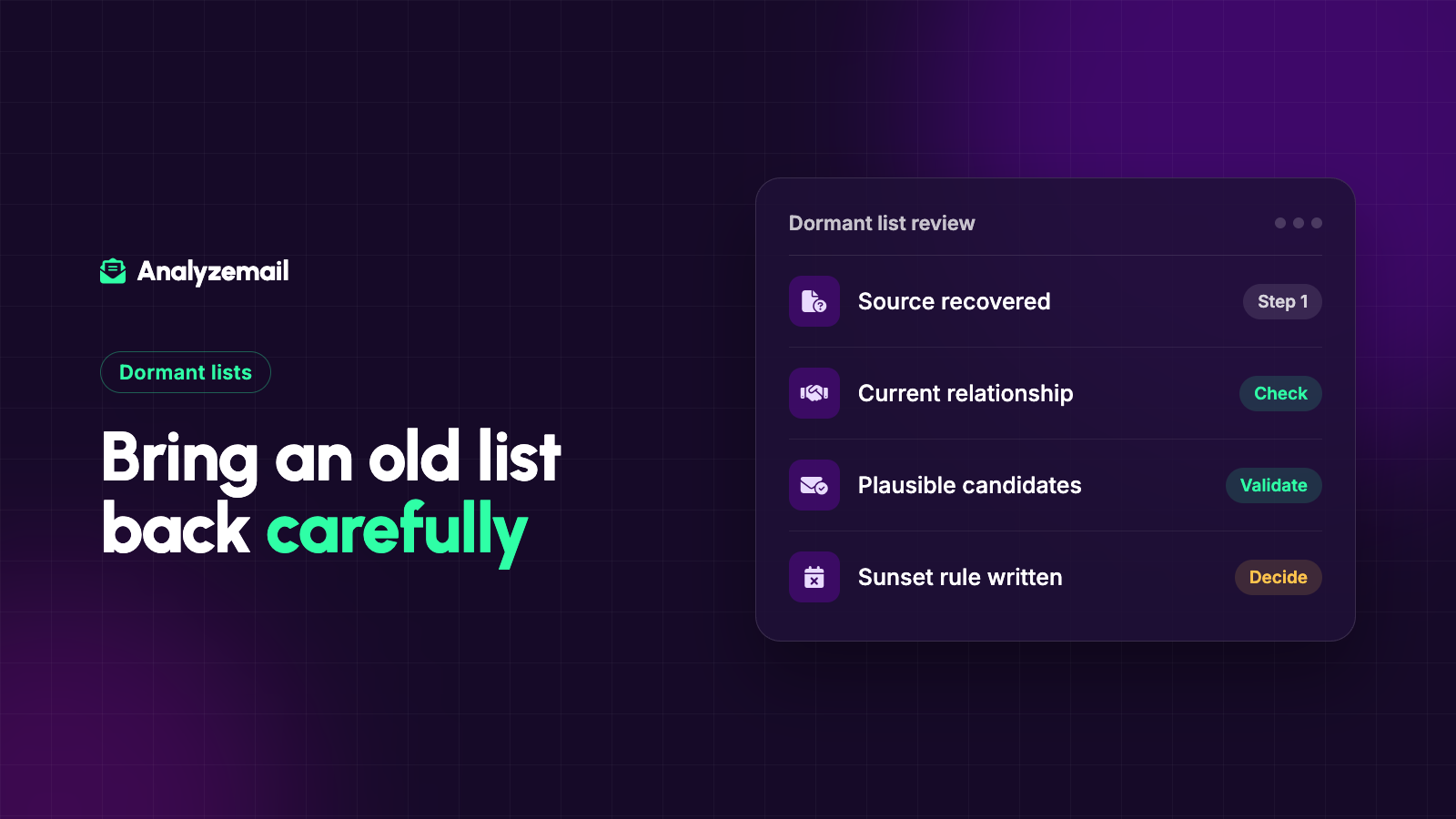
An old email list can look like an easy growth opportunity. You already have the addresses, the audience count is encouraging, and a new campaign seems cheaper than finding new subscribers.
The difficulty is that the spreadsheet preserves the address, not necessarily the relationship.
Someone who subscribed two years ago may not remember the brand. An employee may have changed companies. A record may have been imported without its original preferences. And an existing customer may still be valuable even if they have ignored every newsletter.
Before restarting email, review both technical address quality and the reason each contact should hear from you now. This guide shows how to turn an old file into a documented decision.
Define “old” by the relationship
A contact's age alone is not enough to determine whether it is stale.
An annual conference attendee may reasonably expect an update after a long gap. A subscriber to a weekly tips newsletter may be surprised if the brand disappears for two years and returns with a sales pitch.
Review the original purpose, promised frequency, last relevant interaction, and current relationship. Also consider how much the business has changed. A new brand name, new product, or different audience can weaken the connection between an old signup and a new campaign.
Choose review rules that reflect those differences instead of applying one age cutoff to every record.
Recover the source before checking the address
For each group, try to answer four questions:
- Where did these contacts come from?
- What did they request or expect at the time?
- What is the most recent meaningful interaction?
- Where are the latest unsubscribe and suppression records?
You may find the answers in the CRM, event registration system, previous email platform, or original signup form records.
If the source is unknown, keep that uncertainty visible. A file in the marketing folder is not automatically an approved campaign audience.
This investigation can save unnecessary validation costs. There is little reason to check thousands of addresses if the group should not be included in the planned campaign regardless of the result.
Build a relationship-first inventory
Organize the old list into practical groups before you decide what to send.
| Group | Initial treatment |
|---|---|
| Current customers with relevant contact history | Review preferences and address quality |
| Documented subscribers with a long communication gap | Review original expectations and current relevance |
| Former customers with no recent activity | Assess the relationship before including in marketing |
| Records with missing source information | Hold for investigation |
| Unsubscribed or suppressed contacts | Keep excluded from the relevant campaigns |
These groups should not overwrite your existing customer records. They are a working view for the reactivation project.
Assign an owner to unresolved cases. A shared spreadsheet is more useful when someone is accountable for answering its questions.
Validate the contacts that remain plausible candidates
Once you have identified a candidate audience, check its current technical quality.
AnalyzeMail can assess address and domain findings before the send. Keep clear failures separate from catch-all or inconclusive results, and record the date of the check.
Validation is especially useful here because the address data may have sat unchanged while the people and organizations behind it moved on. However, a favorable result does not restore the original relationship or show that the person remembers subscribing.
For the operational steps, use the email list cleaning guide. For uncertain domain results, see the catch-all review framework.
Do not rely on opens alone to identify valuable contacts
Look for purchases, replies, account activity, event participation, and other relevant actions alongside email metrics.
Mailchimp's documentation on automated activity explains why reported opens and clicks can be affected by nonhuman behavior. That makes a single engagement metric an incomplete basis for a major audience decision.
A person who has not clicked a newsletter may still be buying regularly. Someone with many recorded opens may have little actual relationship with the business.
Write down which signals you will use and why they fit your product or organization. This makes the review more consistent and reduces arguments over individual contacts later.
Decide whether a reintroduction is appropriate
A reintroduction campaign is a communication to eligible recipients, not a way to bypass missing preferences or resolve every unknown record.
If the original subscription is documented and the message remains appropriate, explain who you are, why the person is hearing from you, and what future messages will contain. Make the choice to stop receiving them straightforward.
Avoid opening with a claim that the person is a loyal reader when you have not contacted them in years. Do not pretend a broad reactivation message is a personal reply.
The purpose is to rebuild clarity. A recognizable sender and a specific explanation of the relationship are more useful than manufactured urgency.
A practical reintroduction structure
For an eligible audience, build the message around five elements:
- Recognition: Use the brand name or program the recipient originally knew.
- Context: State the actual reason they are receiving the message.
- Value: Describe the kind of useful information you plan to send.
- Choice: Offer a clear preference or unsubscribe path.
- Restraint: Keep the first message focused on that one purpose.
For example, an annual workshop organizer could remind past subscribers which event series they joined, explain the upcoming schedule, and offer an easy way to manage future updates.
That approach is more credible than sending a generic discount to every old address. The details should come from your records, not from assumptions about why someone joined.
Choose an initial audience you can defend
Start with the group that has the clearest source, strongest current relationship, and appropriate preferences. Exclude unresolved records until the review is complete.
Set your monitoring and pause criteria before sending. Identify who will watch failures and recipient feedback, and who has authority to stop a scheduled follow-up.
The point is not to discover how much risk you can tolerate. It is to learn whether the message fits the audience you selected and whether the data process worked as intended.
Do not expand solely because the first message had a promising open rate. Evaluate actual responses, failures, preferences, and the business outcome relevant to the campaign.
Write the sunset rule in advance
Decide what will happen to contacts who remain inactive or unresolved after the review.
A sunset rule might reduce campaign frequency, remove a group from routine promotions, or place records into an archive according to the tools and retention policies you use. The right action depends on the relationship and system.
What matters is that silence does not result in indefinite inclusion by default.
Preserve enough history to explain the decision and prevent another employee from treating the same file as a fresh opportunity next quarter. Keep suppression decisions enforceable even when a marketing audience is reduced.
Measure the project by usable relationships
The success metric is not how many old addresses you managed to send to. Track how many contacts had a documented source, how many required correction, how many remained eligible, and what meaningful responses followed.
Keep the excluded and unresolved counts visible. They represent decisions that reduce future confusion, even though they do not increase campaign reach.
Also document where history was missing. If the old platform export discarded preferences or source details, improve the current process so the next review is easier.
Give old contacts a current, specific review
An old list can contain valuable relationships. It can also contain records whose context has disappeared. The right workflow separates the two before you send.
Use AnalyzeMail to check the candidate addresses, then combine those findings with the source, preference, and relationship information that determines whether a new message belongs in the recipient's inbox.